Hybrid Infrastructure · Datacentres, Networks & Windows Server

For the years when your datacentre and your cloud run side by side.

We design the connectivity, segmentation, routing and identity that let an on-premises datacentre and Azure or AWS operate together securely, and plan what to extend, migrate or retire.
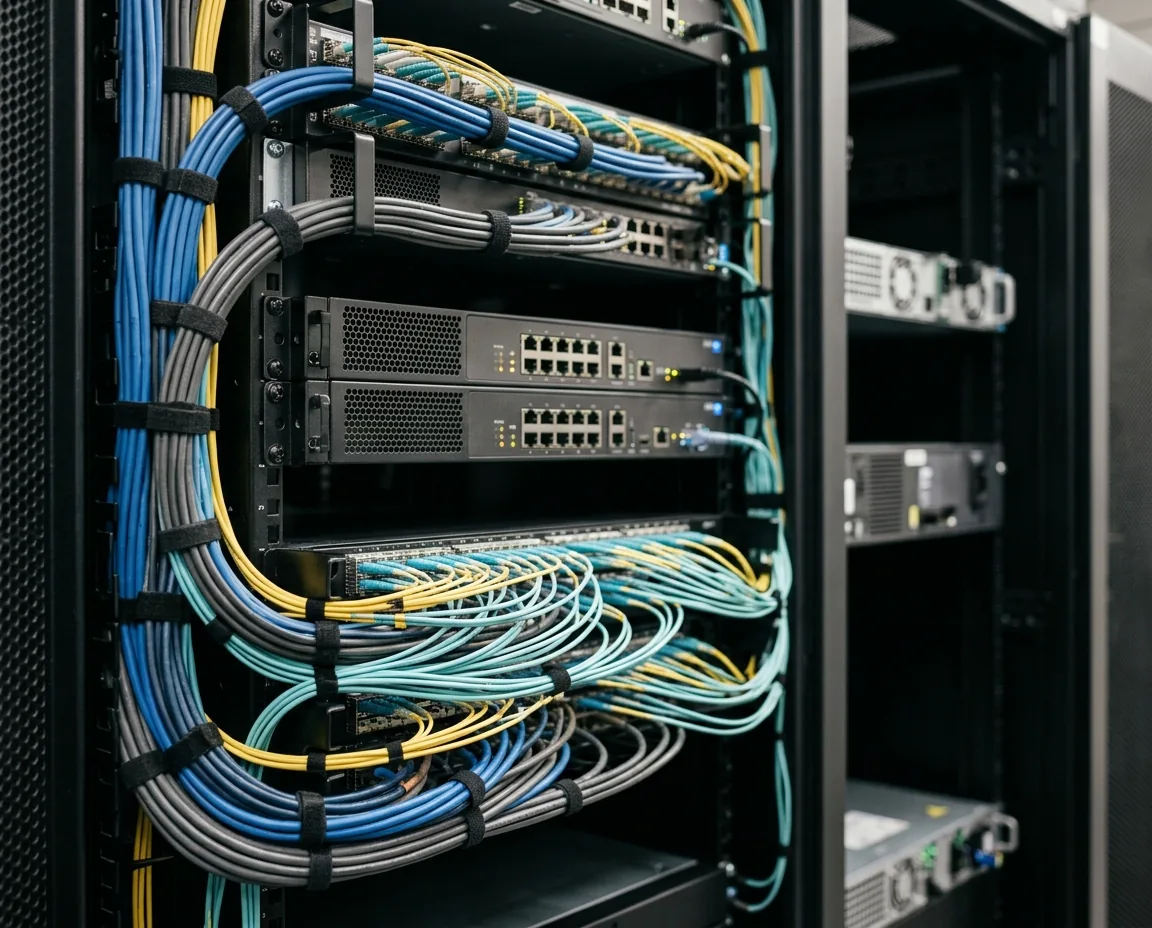
Close-up of enterprise network switching hardware and structured fibre-optic trunk cabling inside a dark perforated steel rack enclosure.
Connected Systems · Cross-Estate Continuity
Zone 1On-Premises CoreWindows Server, VMware clusters, Active Directory and VLAN tiers
Zone 2Hybrid InterconnectRedundant site-to-site VPN tunnels, BGP routing and firewall inspection
Zone 3Cloud Hub ExtensionConditional DNS forwarding, synchronised Entra ID and cloud spokes
Hybrid Infrastructure Scope

What hybrid infrastructure covers

Reliability across datacentres and cloud platforms depends on how circuits, BGP routing, firewalls, DNS and directories connect them.

Why this matters

Colocation renewals, hardware refresh cycles, VMware licensing changes and latency-sensitive workloads mean on-premises systems and cloud platforms must work together reliably. We map undocumented dependencies across circuits, switches, firewalls and Windows Server estates, then engineer a resilient hybrid architecture.

Environments & Technologies Involved
Windows Server and Active DirectoryCisco & Enterprise NetworkingSite-to-Site VPN & FirewallsVMware & Hybrid Azure

Typical situations

  • A colocation contract or hardware refresh is forcing a decision about what moves
  • Changes to VMware licensing have prompted a review of options
  • Site-to-site VPNs and firewall rules have been added over years without an overall design
  • The network is largely flat and segmentation is now a security requirement
  • The Windows Server estate is ageing and needs consolidating or replacing

What you have at the end

  • A map of sites, connections, dependencies and risks
  • A target design for connectivity, segmentation, routing, DNS and identity across datacentre and cloud
  • For each workload: extend, migrate or retire, with the reasoning
  • Implemented connectivity and a sequenced plan, depending on scope
Hybrid Connectivity

Resilient site-to-site VPNs, routing and cross-site links

Redundant encrypted tunnels, dynamic BGP routing and automatic failover paths between datacentres, branch sites and cloud hubs.

Network Segmentation

Firewall zones, VLAN restructuring and lateral boundary control

Flat internal networks are separated into clear security zones for domain controllers, management planes, application tiers and user traffic.

Core Infrastructure

Active Directory, DNS and Windows Server modernisation

Domain controller placement, replication topology, conditional DNS forwarding, DHCP, file services and ageing Windows Server consolidation.

Estate Strategy

Evidence-based decisions on VMware, colocation and cloud extension

Technical dependency, licensing and cost analysis for every cluster and workload to decide what stays on premises, moves to cloud or retires.

Cross-Estate Topology

How the datacentre and cloud connect

Trace how we segment internal networks, build redundant VPN/BGP routing and extend identity and DNS into the cloud.

INTERACTIVE NETWORK PATH WALKTHROUGH

Trace how traffic, DNS and routing cross between datacentre and cloud

Choose a representative traffic flow, inspect each hop along the path, and test how redundant site-to-site VPN and BGP routing behave when a primary tunnel is unavailable.

PRIMARY TUNNEL A · IPSEC + BGP ACTIVESTANDBY TUNNEL B · BGP READYHOP 01DATACENTRE COREOn-Premises VLANHOP 02NAME RESOLUTIONConditional DNSHOP 03HYBRID INTERCONNECTVPN & BGP TunnelsHOP 04CENTRAL INSPECTIONCloud Hub FirewallHOP 05CLOUD WORKLOADProduction Spoke
Hop 03 · Hybrid Interconnect · Normal Path

VPN & BGP Tunnels

Primary IPsec tunnel (BGP AS-path preferred) carries encrypted traffic to the cloud hub gateway.

Infrastructure Scenarios

Example scenarios

How production sites, circuits and servers are connected or modernised within regional maintenance windows.

Scenario 01 · Hybrid Extension

Connecting an existing datacentre to a new Azure or AWS environment

Operational trigger
Core manufacturing or ERP systems remain on premises while analytics and new application tiers extend into the cloud.
Engineering approach
Map Cisco and firewall routing, design redundant site-to-site VPNs with BGP, align conditional DNS and AD sites, and segment traffic.
Typical outcome
Predictable routing, unified name resolution and enforced firewall boundaries between datacentre and cloud.
Scenario 02 · Network & Firewall Redesign

Segmenting a flat enterprise network and rationalising legacy VPNs

Operational trigger
Years of ad-hoc firewall rules and tunnels have left the internal network flat and difficult to troubleshoot or audit.
Engineering approach
Inventory active traffic flows, design a segmented zone architecture, stage rule changes in maintenance windows and verify rollbacks.
Typical outcome
Documented network segmentation, clean routing tables and isolated management and infrastructure tiers.
Scenario 03 · Colocation & Virtualisation Review

Planning a colocation renewal, hardware refresh or VMware transition

Operational trigger
An upcoming lease expiry or virtualisation licensing change requires a clear technical decision on which workloads move and which stay.
Engineering approach
Assess server dependencies, storage I/O and network constraints, compare options with explicit cost and risk assumptions, and sequence waves.
Typical outcome
A practical, costed decision matrix and a phased execution plan that avoids rushed contract renewals.
Enterprise colocation and hybrid cross-connect corridor with dual-path overhead fibre raceways and dark steel equipment racks.
Infrastructure Delivery Sequence

How a hybrid infrastructure engagement runs

We map undocumented dependencies first, weigh options for every workload, and implement network and server changes with tested rollback gates.

  1. 01

    Map

    Sites, circuits and VPNs, firewalls, DNS, Active Directory, and the applications that depend on each. The undocumented dependencies are usually the ones that decide the plan.

  2. 02

    Decide

    For each workload or platform: keep it on premises, extend it into Azure, re-platform it, or retire it. Each option comes with its cost assumptions, risks and open questions.

  3. 03

    Design

    Connectivity, segmentation, routing and name resolution across datacentre and cloud, and how identity spans both.

  4. 04

    Implement

    Changes are made inside your change process, with maintenance windows that respect every region you operate in and a tested rollback for each network change.

Scope note

An engagement can stop at the assessment and decision, or continue to design and implementation. The statement of work says which.

Ways to Work With Us

Complete projects or senior specialists in your team

Deliver a defined hybrid infrastructure project end to end, or embed senior network and systems specialists in your team.

Compare both engagement models on How we work
ONIIOCO-led delivery · Single accountable supplier

Complete projects

ONIIOCO maps your sites and dependencies, produces the hybrid network and workload decision architecture, and implements the agreed VPN, firewall, DNS and server changes through handover.

Client-led programme · Embedded senior specialists

Specialist engagements

Senior ONIIOCO network and infrastructure specialists join your internal team to resolve routing and firewall issues, design VLAN segmentation or support a colocation and VMware transition.

Next step

Describe your estate.

Roughly how many sites and servers, which platforms, and the decision or date that is driving the work.